
If there was one thing you were going to focus on when it comes to health, it should be getting enough fiber. Fiber is essential for good health!
Having enough fiber in your diet is important for more than just avoiding constipation.
Fiber aids in proper digestion, weightloss and can decrease cancer risk. 1
It can also help moderate blood cholesterol levels, blood pressure, blood sugar, and gastrointestinal health. 2
A new study in the Annals of Internal Medicine, found that simply focusing on fiber is as effective at weight loss as more complex diets. 3
Fascinating! Eat more plants, lose more weight!
How much fiber should I consume?
The Institute of Medicine recommends a minimum of 38 grams of fiber for men 50 years and younger and 30 grams for men over 50 years. Women 50 years and younger should get 25 grams and those older than 50 should get 21 grams.4.
According to Dr. Michael Greger, “less than 3 percent of Americans get even the recommended minimum adequate intake of fiber.” 5 Most Americans are only getting a mere 10-15 grams. 6
Dr. Neal Barnard founder of the Physicians Committee for Responsible Medicine says you should aim for 40 grams of fiber a day. 7
What are Fiber-rich foods?
Only plant-based foods such dates, flax seeds, chia seeds, dark leafy green vegetables and beans contain fiber so eating more plant-based foods is a great way to boost your fiber intake!
There are two types of fiber:
Soluble Fiber which is found in oats, nuts, seeds, legumes and many fruits and
Insoluble Fiber which is prevalent in whole wheat, wheat bran, brown rice, other whole grains and most vegetables. 8
Tips on how to incorporate more fiber into your diet:
1. Eat more plants: Eat a variety of fruits, vegetables, beans, and whole grains. Natural fiber (the best source of fiber) is only found in whole plant-based foods. Tip: make sure half of your plate is fruits and vegetables.
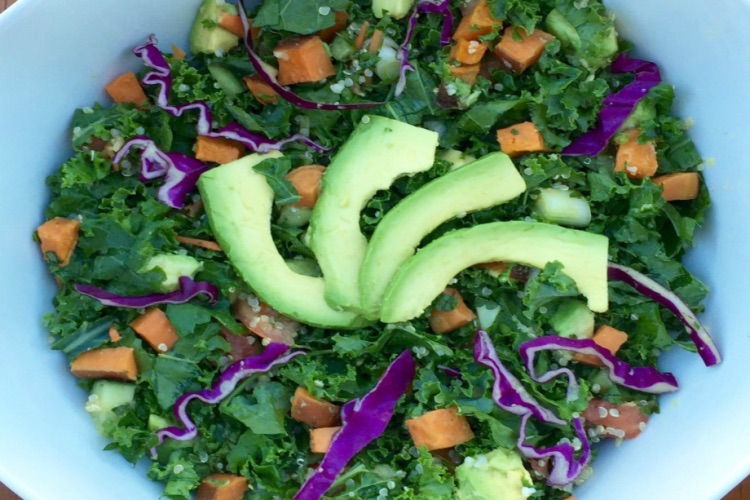
2. Have a daily salad: Salads are a great way to boost your intake of natural fiber as well as increase your consumption of leafy greens and other vegetables. Adding fats to your salads like avocados helps you extract all of the other nutrients especially the fat soluble vitamins (A, D, E and K) in your salad.
3. Try the five to one fiber rule:
When you are in the store see if that cracker, bread or cereal you are thinking about buying passes the five to one fiber test. Dr. Michael Greger of NutritionFacts.org explains that to figure out if your cereal or bread product passes the test divide the total grams of carbohydrates in the product by grams of fiber and the number should be five or less. 9
You’ll quickly see that not many products in the store pass this test. One product that did manage to pass the test was Uncle Sam’s breakfast cereal that got a ratio under 4!
So check out your local grocery store and see if you can find any breads or breakfast cereals that meet the 5 to 1 ratio rule.
Fiber is such an important nutrient in a healthy diet! Eating lots of nutrient-dense whole plant foods is the best way to ensure that you are getting all the fiber you need.
- http://www.pcrm.org/nbBlog/index.php/fiber-is-the-key-to-good-health ↩
- Warsaw’s Perspectives in Nutrition, Tenth Edition ↩
- http://annals.org/article.aspx?articleid=2118594 ↩
- http://iom.nationalacademies.org/Activities/Nutrition/SummaryDRIs/DRI-Tables.aspx ↩
- http://nutritionfacts.org/2015/09/29/where-do-you-get-your-fiber/ ↩
- http://www.pcrm.org/nbBlog/index.php/fiber-is-the-key-to-good-health ↩
- http://www.pcrm.org/health/diets/weight-loss/feel-your-best-this-year ↩
- R B Baron. Eat more fibre. BMJ 2013; 347 ↩
- http://nutritionfacts.org/video/the-five-to-one-fiber-rule/ ↩
Recent Comments